Full Script of Chinese Ambassador to Lesotho Yang Xiaokun’s Interview with Lesotho Television Regarding the Fifth Plenary Session of the 20th Central Committee of the Communist Party of China
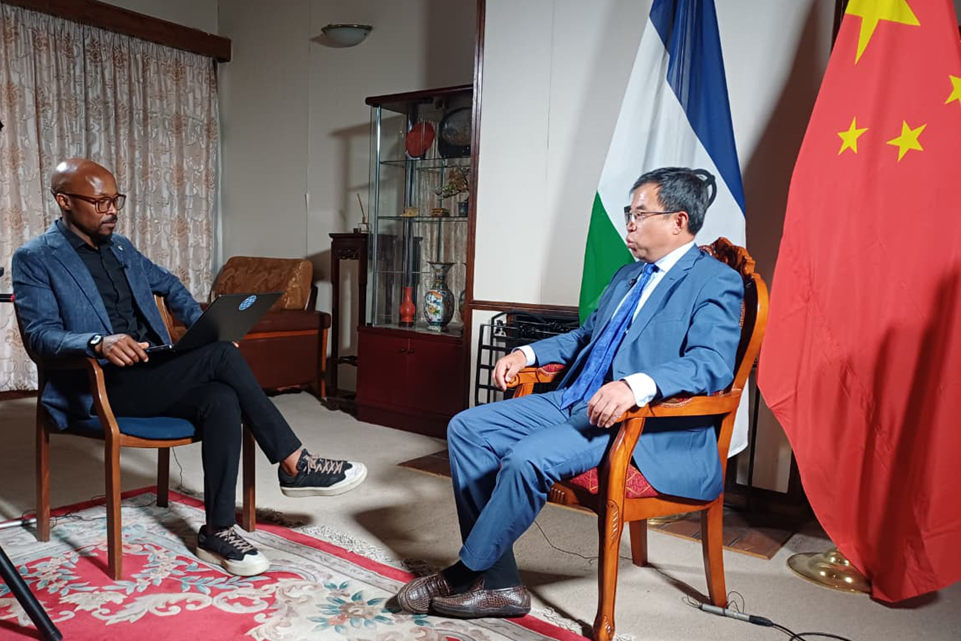
On November 5, 2026, Chinese Ambassador to Lesotho Yang Xiaokun was interviewed by Lesotho Television (LTV). He introduced the guiding principles of the Fifth Plenary Session of the 20th Central Committee of the Communist Party of China, “China Opportunity 2.0”. The interview transcript is as follows:
1. The Fifth Plenary Session of the 20th Central Committee of the Communist Party of China recently concluded. What was the most important outcome of the Fifth Plenary Session of the 20th Central Committee of the Communist Party of China?
The 20th Central Committee of the Communist Party of China convened its fifth plenary session in Beijing from October 26 to 29, 2026. The most important outcome of the plenary session was the deliberation and adoption of the Resolution of the Central Committee of the Communist Party of China on Certain Major Issues concerning Persevering with Full and Rigorous Party Self-Governance.
The resolution examines new circumstances, challenges and tasks facing the Party as it advances full and rigorous Party self-governance. It identifies three increasingly arduous tasks for the CPC: safeguarding China's sovereignty, security and development interests amid a changing international environment; advancing reform and development while maintaining social harmony and stability at home; and preserving the Party's advanced nature and integrity. It also warns that, under new circumstances marked by profound changes, the Party faces challenges to its governance and leadership capacity, the quality of its membership, and its resistance against corruption and moral decline. The resolution has established a problem-oriented approach as one of the guiding principles for persevering with full and rigorous Party self-governance. It places particular emphasis on strengthening Party spirit among CPC members, as problems in Party conduct and discipline often stem from a lack of strong Party spirit. The resolution sets out specific measures to ensure that Party members and officials remain loyal, upright, and responsible.
As General Secretary Xi Jinping has pointed out "No other political party in the world takes its own development as seriously as the CPC does, or advances its own self-reform with such a high degree of self-awareness, scientific rigor and systematic effort. This is a distinctive strength of our Party."
2. What key measures did the Fifth Plenary Session of the 20th CPC Central Committee outline to advance full and rigorous Party self-governance?
The Fifth Plenary Session of the 20th Communist Party of China (CPC) Central Committee has drawn close attention for its core agenda: strengthening full and rigorous Party self-governance, with a landmark document tabled for deliberation.
As China enters the 15th Five-Year Plan period (2026-2030), a critical stage in laying the groundwork for basically achieving socialist modernization by 2035, the CPC faces severe challenges: strengthening its governing capacity, staying connected with the people, guarding against complacency and resolutely combating corruption.
Only through strong Party leadership and unwavering commitment to full and rigorous self-governance can central leadership decisions be fully implemented and the country's long-term development stay on course.
For more than a decade, the Party has emphasized advancing this effort, calling for higher standards and more concrete measures to strengthen full and rigorous Party self-governance.
Systematic plans for persevering with full and rigorous Party self-governance were also made at the session with the emphasis on strengthening the Party spirit of Communists; strictly practicing democratic centralism; cultivating high-caliber officials capable of shouldering the mission of national rejuvenation; building a well-knit organizational system characterized by cross-level alignment and effective implementation; improving conduct and tightening discipline on an ongoing basis; taking firm and coordinated action against corruption; running the Party with systems and regulations; refining Party and state oversight systems; and ensuring all responsibilities of Party self-supervision and self-governance are fulfilled in earnest.
The message is clear: Party self-governance is a continuous endeavor, with no finish line, only new starting points. The CPC will continuously strengthen its capacity to serve the people better.
3. Regarding the Taiwan question, China has consistently emphasized its commitment to peaceful reunification while stating that it does not renounce the use of force. Against this backdrop, has China considered using military means to resolve the Taiwan question? How does China view the relationship between peaceful reunification and the possibility of taking non-peaceful measures?
Resolving the Taiwan question and realizing China's complete reunification is a shared aspiration of all the sons and daughters of the Chinese nation. It is indispensable for the realization of China's rejuvenation. It is also a historic mission of the Communist Party of China (CPC). The CPC, the Chinese government, and the Chinese people have striven for decades to achieve this goal.
Taiwan has been an integral part of China's territory since ancient times. Moves to separate Taiwan from China represent the serious crime of secession, and undermine the common interests of compatriots on both sides of the Taiwan Straits and the fundamental interests of the Chinese nation. They will lead nowhere.
National reunification by peaceful means is the first choice of the CPC and the Chinese government in resolving the Taiwan question, as it best serves the interests of the Chinese nation as a whole, including our compatriots in Taiwan, and it works best for the long-term stability and development of China. We have worked hard to overcome hardships and obstacles to peaceful reunification over the past decades, showing that we cherish and safeguard the greater good of the nation, the wellbeing of our compatriots in Taiwan, and peace on both sides.
The One Country, Two Systems principle is an important institutional instrument created by the CPC and the Chinese government to enable peaceful reunification. It represents a great achievement of Chinese socialism. Peaceful reunification and One Country, Two Systems are our basic principles for resolving the Taiwan question and the best approach to realizing national reunification. Embodying the Chinese wisdom - we thrive by embracing each other - they take full account of Taiwan's realities and are conducive to long-term stability in Taiwan after reunification.
We will work with the greatest sincerity and exert our utmost efforts to achieve peaceful reunification. But we will not renounce the use of force, and we reserve the option of taking all necessary measures. This is to guard against external interference and all separatist activities. In no way does it target our fellow Chinese in Taiwan. Use of force would be the last resort taken under compelling circumstances. We will only be forced to take drastic measures to respond to the provocation of separatist elements or external forces should they ever cross our red lines. Our ultimate goal is to ensure the prospects of China's peaceful reunification and advance this process.
4. We noted that some foreign media outlets coined the word “Chinese squeeze” “China Shock”, saying that Chinese manufacturing not only sends shockwaves to Western countries, but also squeezes out space for Global South countries who seek industrial development. What is your comment?
In recent months, some Western countries have once again revived claims of so-called “China overcapacity”, repackaged them under the label “China Shock 2.0.” This narrative appears designed largely to divert attention from their own structural economic challenges.
Using this framing as justification, these countries have introduced discriminatory trade restrictions that disrupt the stability of global industrial and supply chains. By politicizing normal market competition and turning industrial development into a geopolitical tool, such actions run counter to the principles of market economics and free trade, amounting to a form of protectionist rhetoric.
In response, China recently released China’s Position on the So-called Excess Capacity Issue, outlining its policy stance and clarifying the facts. The reality is clear: China’s industrial development represents not a “China Shock 2.0” but a “China Opportunity 2.0.”
To simply equate trade surplus with overcapacity is a misunderstanding of the basic logic of international trade. China’s export growth is propelled by the progress in economies of scale and innovation, as well as the actual demand from other countries for green transition and industrial development.
Throughout economic history, major manufacturing powers — including the United Kingdom, the United States, Germany, and Japan — have maintained large trade surpluses for extended periods. Even today, the United States exports 80 percent of its chips, while the European Union always sees gigantic trade surplus in automobiles, pharmaceuticals and other advantageous sectors. Would it be reasonable to label these countries with “overcapacity” under the same “surplus equals overcapacity” logic?
China’s industrial development brings tangible opportunities, not so-called “shocks” to the world. Over the past decade, China has remained a major engine of global growth, contributing roughly 30 percent to the global economy. “China Opportunity 2.0” is a vivid example of the country engaging with the world and pursuing win-win outcomes.
Facts have proven that China brings the world not “shocks” but opportunities; it does not “squeeze” but enables growth. The affordable quality products made in China has lowered the threshold of industrialization for developing countries. China’s open-source and universally beneficial innovation has enabled more countries to access affordable cutting-edge technologies. China’s stable and reliable supply has strengthened the resilience of the global industrial and supply chains, and supported Global South countries’ pursuit of modernization at a faster pace.
China will always stand together with fellow developing countries. We should view industrial cooperation in light of the law of international division of labour, and reject the simplistic argument that large export volumes or trade surpluses equal excess capacity, as well as protectionist practices. China’s zero‑tariff treatment for all African diplomatic partners is a vivid embodiment of “China Opportunity 2.0”. Through voluntary unilateral market opening, it expands access for African goods to the Chinese market, helps Africa nurture local industries and integrate deeper into global industrial and supply chains.
For Lesotho, the zero-tariff policy opens up important opportunities. It provides greater access for Lesotho’s products, particularly its wool and mohair, to China’s vast consumer market. While the removal of tariffs alone cannot guarantee an immediate increase in exports, it removes an important trade barrier and creates favourable conditions for Lesotho to move beyond raw material exports towards fibre processing and higher-value textile production, supported by investment, technical expertise and stronger market linkages.
More broadly, the policy can help stimulate business growth, create local employment, strengthen domestic supply chains and diversify Lesotho’s productive sectors, while opening up new opportunities for deeper industrial cooperation between China and Lesotho in areas such as processing, manufacturing, logistics and product development. It also reflects China’s commitment to shared development and to enabling developing countries to participate more fully in global trade.
Ultimately, the success of this policy should be measured not simply by the removal of tariffs, but by the tangible benefits it brings to the people of Lesotho — more business opportunities, more jobs, stronger local industries and better prospects for sustainable development.
5. October 25 is a day of great historical significance for China. It marks both the 55th anniversary of the restoration of the People's Republic of China's lawful seat in the United Nations and the Commemoration Day of Taiwan's Restoration. Could you elaborate on the historical significance of these two events and explain the connection between them?
On October 25, 1971, the 26th session of the UN General Assembly passed Resolution 2758 by an overwhelming majority, deciding to restore all the rights of the People's Republic of China at the United Nations, recognize the representatives of the government of the People's Republic of China as the sole legitimate representatives of China at the UN, and return the representation and seat of all of China, including Taiwan, to the government of the People's Republic of China. This marked the return of the Chinese people, or one-fourth of the world's population, to the UN stage. It was a momentous event for both China and the wider world.
Over the past 55 years, China has always been a builder of world peace, a contributor to global development, and a guardian of the international order. We firmly support the UN in playing a central role in international affairs, actively participate in the work of the UN in various fields, and faithfully fulfill our duties as a permanent member of the UN Security Council. Through the UN, we work to strengthen solidarity and cooperation with other countries, advocate for common security, promote shared development, foster dialogue among civilizations, and advance the reform and improvement of global governance.
Standing at this new starting point of history, China will continue to shoulder its responsibility as a major country, further deepen cooperation with the UN across the board, jointly tackle global challenges, and build a community with a shared future for humanity.
October 25 also marks the Commemoration Day of Taiwan's Restoration. Taiwan has been Chinese territory since ancient times. Archeological discoveries and research findings regularly attest to the profound historical and cultural ties between the two sides of the Taiwan Strait. Numerous historical records document the development of Taiwan by the Chinese people since the very early days.
The earliest recorded reference to the development of Taiwan by the Chinese people is in the Seaboard Geographic Gazetteer of the year 230, more than 1,000 years earlier than Columbus’s discovery of the New World. The central governments of China set up administrative bodies in 1087 to exercise jurisdiction over Taiwan. Dutch colonialists invaded and occupied the southern part of Taiwan in 1624, and Taiwan was called “Formosa” by the Dutch colonialists. They only occupied a small part of Taiwan for 38 years. Chinese General Zheng Chenggong expelled Dutch colonialists from Taiwan in 1662. Japan launched an aggressive war against China in 1894 and defeated the then Qing government of China. Taiwan was ceded to Japan as a result of the war. The secession is temporary and the separation of Taiwan from the mainland lasted 50 years until 1945.
1945 marked the victory of the Chinese People’s War of Resistance Against Japanese Aggression and the World Anti-Fascist War. That means Taiwan’s return to China forms a vital part of the outcomes of World War II and the post-war international order. Including The Cairo Declaration, The Potsdam Proclamation and Japanese Instrument of Surrender, a host of documents stated that all the territories Japan had stolen from China, such as Northeast China, Taiwan and the Penghu Islands, should be restored to China, providing strong and sound international legal effect, basis and source. On October 25, 1945, the Chinese government resumed the exercise of sovereignty over Taiwan.
Taiwan’s restoration is an important outcome of the victory of the Chinese People’s War of Resistance Against Japanese Aggression, a piece of irrefutable evidence that China resumed exercise of sovereignty over Taiwan, and a key part of the fact that Taiwan is part of China supported by both history and law. October 25 is designated as the Commemoration Day of Taiwan’s Restoration and commemorative activities in various forms are organized on this day, according to the decision adopted on October 24, 2025 at the 18th session of the Standing Committee of the 14th National People’s Congress.
The restoration of Taiwan and the restoration of New China's lawful seat in the United Nations are therefore closely linked. Both are important historical events reflecting the restoration and defence of China's sovereignty and legitimate rights, as well as the upholding of the outcomes of the Second World War. They demonstrate the importance of respecting history, international law and the post-war international order, and reaffirm the one-China principle and the fact that Taiwan is an inalienable part of China's territory.